On Writing Jane, Unlimited: Please Don’t Choose Your Own Adventure

Before I start, a couple of important things:

There’s a documentary airing on Monday on PBS called Unrest, about MECFS (Myalgic Encephalomyelitis/Chronic Fatigue Syndrome). I hope you’ll watch it and pass the word on. Official blurb: “Jennifer Brea is working on her PhD at Harvard and about to marry the love of her life when she’s struck down by a mysterious fever that leaves her bedridden. When doctors tell her ‘it’s all in her head,’ she turns her camera on herself to document her devastating symptoms. Searching for answers, Jennifer discovers a hidden world of millions confined to their homes and bedrooms by ME, commonly known as chronic fatigue syndrome. Together, Jen and her new husband, Omar, must find a way to build a life and fight for a cure.”

MECFS is a devastating illness that has not received the attention it needs from the medical community, for all sorts of f***ed-up reasons. Many of the people with this disease can’t be their own activists – they are too sick. So please, watch the trailer, watch the movie (check your favorite streaming services if you don’t have access to PBS), and pass the word on. Maybe if we make enough noise, something will change in the medical community.

Next, do you know the animal photography of Tim Flach? He’s got a beautiful portraiture style and I particularly love his presentation of endangered animals. Definitely worth a click today.

In a similar vein, check out the winners of the Wildlife Photographer of the Year contest at London’s Natural History Museum.

******

So. Writing Jane, Unlimited presented a lot of unique challenges. I’ve already written about Webs Versus Lines. Today I want to talk about an aspect of the book that changed over time: its choose-your-own-adventure structure.

If you’ve read Jane, you know that at a certain point, the book splits off into five different stories. First comes a mystery story, followed by a spy story, followed by a horror story, followed by a sci-fi story, followed by a fantasy story, in that order.

Well, in most of the early drafts of Jane, at the point where the book splits off into five different stories, it was up to the reader to decide which story to read next.Why? Because I envisioned the book as a choose your own adventure, an interactive kind of book in which the reader is offered choices and gets to decide what happens next. My expectation/hope was that the reader would read all five stories, but in whatever order appealed to them.

(Choose your own adventures are also often written in the second person point of view, the conceit being that you, the reader, insert yourself into the story, pretending to be the main character. Accordingly, the first many drafts of Jane were indeed written in the second person point of view…which was incredibly challenging and complicated and created all sorts of problems. But I’m going to have to blog about that some other day, when I have more brain space!)

From the get-go, the reader’s choice aspect created major challenges. Why? Well, let me explain a little bit about the writer’s job of Planting Clues.

This is a book in which clues matter. There are a LOT of things going on, and a lot of things link to a lot of other things. For example, you might pick up a clue in the mystery story that doesn’t come to fruition until the horror story or the sci-fi story. You might leave the spy story not understanding a part of that story… until you get to an explanatory scene in the fantasy story. It’s my job as the writer to fill the book with hints and clues that will form a sort of web for the reader, a web that they’re gradually able to start filling in for themselves, with those “Aha!” moments, those “Ooo, I bet I know what’s going on!” moments, and those “Holy crap, I didn’t see that coming!” moments, that make reading a book so fun. If you’re having that experience while you’re reading a book, it’s because a careful writer has orchestrated that experience for you from behind the curtain.

And you know what matters to the reader’s experience of Clue Absorption?

Timing.

For example, if the reader reads a clue about a mysterious man in a strawberry beanie on page 10, then doesn’t encounter another clue about the man in the strawberry beanie until page 310… We have busy lives. We put our books down to make dinner or bathe the child or visit our parents in New Jersey. So, there’s a good chance that by the time the reader gets to the man in the strawberry beanie on page 310, they’ll have forgotten about the man in the strawberry beanie on page 10. It’s been too long. The later clue will consequently ring no bells, strike no notes, conjure up no memories. The reader will not have that fun “Aha!” moment where they finally understand who that beanie-wearing fellow is. On the other hand, if the reader is getting clues about the beanie man every fifteen pages, the revelation won’t even be a revelation; it’ll be too obvious.

In a choose your own adventure, as I’ve already explained, the reader gets to decide in what order they read the book. You know what the writer has absolutely no control over, if the reader gets to decide in what order they read the book?

Timing.

If you get to decide which of my five stories you read first, then I have no idea how long it’s been since you last got a clue about the man in the strawberry beanie. Or the woman in the patent leather shoes, or the non-binary person eating a banana split. If I don’t know in what order you’re reading my stories, I don’t know where to plant my clues and follow-up clues. I don’t know if at any point, you’re receiving too many clues or too few. And here’s the thing: if the reader is reading a book, and the clues are piled on top of each other too closely, then the reader feels like the author thinks they’re stupid. If the reader is reading a book, and the clues are too few and far between for the reader to understand or remember… then the reader feels stupid.

The reader isn’t stupid! The reader is a genius, and a necessary organism in the symbiotic relationship between people and books that gives books meaning. If a book is ever making you feel stupid – or making you feel like the author thinks you’re stupid – the author probably screwed up. Alternately, it’s just not the book for you; no book works for everybody. The latter explanation is okay. The former one, when it happens, is a shame.

So anyway… around the time I realized second person POV was not serving my story, I also realized that my job would stop being completely impossible if I took back control of the order in which people read the parts of my book. This also meant that I stopped getting early readers who came back to me with the terrible news that they’d read the horror story first, or, even worse, last. I’m so sorry. That must have been horror-ible.

It also allowed me to nudge my themes in certain ways, and know how my reader was experiencing them. It allowed me to control the pacing of important revelations. It allowed me to guide the reader  from serious to absurd and back again; it allowed me to plant the moments of greatest emotional impact where I thought they fit best. It was such a relief to have control over these things again!

My brilliant editor, by the way, knew from the beginning that I was going to be better off once I let go of the choose your own adventure conventions. It took me many drafts to understand it for myself. Kathy, thank you for your incredible patience.

And so. This is why Jane, Unlimited is a book in which Jane gets to choose her own adventure…. but the reader does not. :o)

Godspeed to all writers.

We got 17 inches of snow yesterday. Here’s a local hair salon that has the right idea about window decor :o)

In Which the Author Makes a Star

I found a pattern for a 20-sided star online (called a Moravian star). 
While I printed it out, Kevin went through my wrapping paper collection and chose a really lovely one made of an old German map of Europe.
I cut out twenty of these….
…to turn into twenty of these.
At a certain point, it occurred to me that wrapping paper isn’t the strongest stuff in the world. I wanted this to be a star for us to use every year, a hearty star with a long life… so I decided I needed to make understar parts out of cardstock, then attach the wrapping paper parts to the cardstock parts. I began to cut out and create twenty of these.
I also made the icosahedron (20-sided polyhedron) above out of cardstock, using the pattern below. (Here’s another link to this great pattern, by Charlotte@Living Well on the Cheap!)
Of course I didn’t think about the fact that I might want to blog this later, so my pictures are random and disorganized… sorry about that.
Next, I glued the twenty points to the icosahedron. This was funny at times. It looked like a weird pointy undersea creature.
I realized at some point that I needed to cover the edges of the icosahedron with the map paper, because otherwise the white of the cardstock was peeking through.
Done! In the picture below, it looks huge, but that’s just the weird framing in relation to that chair. It’s maybe eight or ten inches in diameter.
It was heavier than we were expecting. We stuck a 3M hook to the ceiling above the Christmas tree and did a test run to see if it could support the weight. :o)
I left for the office and got a text message a few hours later that said, “The shoe fell :(“
The placement of the hook and shoe had been a little bit of a project, so I was expecting another project with the proper ceiling hooks when I got home. Instead, when I walked through the door this evening, this is what I saw.
I’m not sure if it’s clear how cool it looks! Kevin suspended it about an inch above the tree, on a transparent string. It looks impossible.
And that was my star-making adventure :o). Happy December, everyone.

Costumes!

The news is relentlessly bad, triggery, and heartbreaking. I go back and forth about these blog posts, because I don’t want to seem frivolous when so much bad stuff is going on. But — I want to celebrate our creativity, and I also want to express gratitude for our friends who’ve made a recent four weeks of costume parties possible. And I’m also hoping that our silly costumes will bring a smile to the face of you, Reader.

I’ve already blogged about the Babadook and the library :o)

Here’s what it was like anytime Kevin wanted a drink.

Next was the eighties party. In case you’re wondering,
that thing on my head is called a deelybopper!

Then — THEN — we took part in a ’60s spy murder mystery!!!

In this picture, Kevin, a CIA agent, is trying to determine who murdered his colleague, an MI6 agent, while I look on pretending to help but NOT REALLY HELPING BECAUSE I WAS A PRETEND MI6 AGENT WHO WAS ACTUALLY A KGB DOUBLE AGENT AND I GOT TO LIE TO EVERYONE ALL NIGHT LONG AND OMG IT WAS SO FUN!  Thanks for the picture, Sarah H, and thanks for organizing this wonderful party, J&J. And thanks to all our goofy friends who got into their roles and made this so much fun. :o)

Next, a friend’s spectacular costume birthday party! Kevin was sort of a… creepy suited fairy?

Not so creepy after all. I enjoyed his wings.

And I was the ocean! No, I did NOT make that ship :o). But it is one of my favorite possessions.

No more costumes for us for a while. But I’m brainstorming next Halloween :o).

And that’s that. I hope you are finding some light this November, dear readers.

How to Order Signed Copies

‘Tis the season et cetera, so here’s a reminder about how to order signed/personalized copies of my books from my local indie, Harvard Book Store. If you click on this link, it’ll take you to the store’s inventory of my books. There you can place your order. Just be sure to note in the comments field whether you’d like it signed and personalized, and, if personalized, to whom. I also tend to write a brief inscription of my choice, and am happy to add birthday or holiday greetings, encouragement to writers, etc., if requested. If you’re tempted to ask me to inscribe something beyond that, please note that I’ll only do so if it’s something I feel comfortable signing my name to.

One last note: Though I do still live nearby, I no longer live right around the corner from the bookstore. I can’t always get into the store right away, so if you’re buying holiday presents, don’t delay!

Thanks everyone :o). More soon – I’m planning another blog post about how I wrote Jane!

In Which the Author Makes a Library Costume. Plus, a Bonus Babadook!

This year, for Halloween, I was a library.
Kevin took most of these pics with Fancy Camera. Click on any pic to embiggen/get a more focused view.
Last year, while searching for appropriate teapot/flower fabric for my Mad Hatter costume, I stumbled across the book fabric shown in the skirt above. That’s when I realized I wanted to be a library this year… I’ve been planning this costume for over a year :o).  
I made most of this costume myself, including the skirt, top, and hat. The “QUIET PLEASE” sign on the top is cut out of felt. I glued it on while wearing the top and looking in the mirror (bugging Kevin every three minutes to ask if any of my letters were backwards), because that was the only way to know how it would look while I was wearing it.
Same with the book spines that make up the torso. I found old, falling apart books no one wanted, removed the spines, and attached them to a bustier, with staples, thread, and fabric glue, while wearing the bustier… because the bustier was stretchy, and this was the only way to know exactly where and how things needed to be attached. This bookshelf torso took FOREVER, way longer than I was expecting, and was physically challenging. I kept having to take it on and off, and a bustier has about 7 million hooks that are hard to reach. AGH. I’ve decided that my costume next year is going to involve fewer headaches. Of course, that’s what I think every time I start writing a new book too, and it always turns out that every creative project comes with its own surprise headaches :o).
It might be hard to see in the picture below, but I attached stickers with the correct Library of Congress call numbers to each book.
Now for the accessories… Sense and Sensibility is my favorite Jane Austen book. I got the book necklace below from PetitePages on Etsy.
Kevin loves Sherlock Holmes, and, as anyone who’s read Jane, Unlimited knows, I love Rebecca :o). I made the earrings below out of miniature books I got from LDelaney on Etsy.

I wore library card socks that came from Out of Print Clothing.
Finally, my library catalog fascinator.

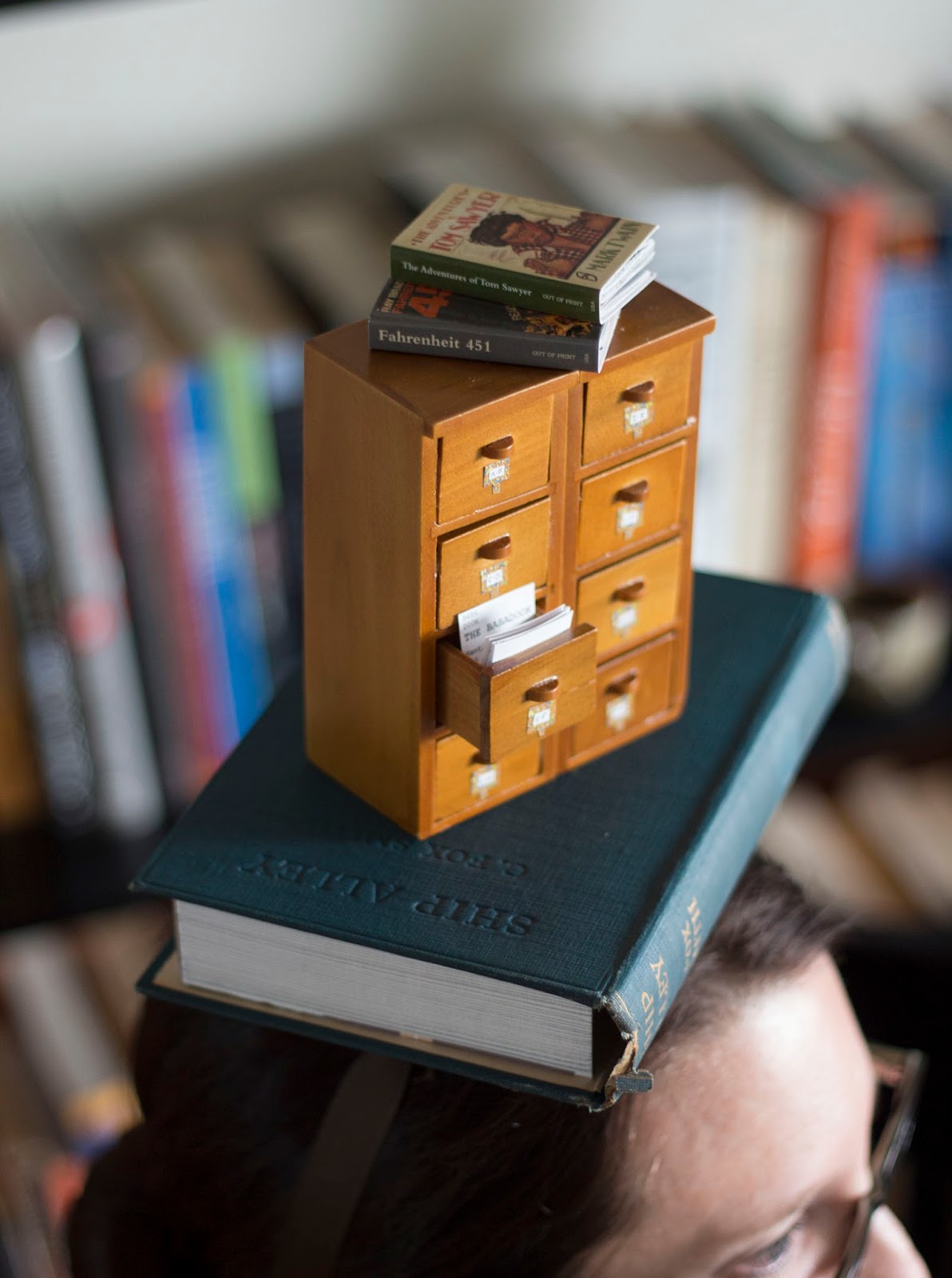
Kevin found two tall drawers for me on a dollhouse furniture website (after talking me down from trying to wear a drawer-parts cabinet like this one on my head). I glued them together and put little stickers on them showing ranges of letters.

I also gutted a book, gave it cardboard supports so it would look like it had pages, cut a hole in it for my head, and attached ribbons to tie it behind my head. I slapped on a piece of felt too, because it was cutting into my scalp a little bit in the front. (Thank you, Jay, for that suggestion ^_^.)

In the interest of making it as light and steady as possible, I took out all the drawers but one and broke off all the wood behind the front pieces, then glued the front pieces in place. Then I glued my one open drawer and all its cards in place too.

Two books sat on top of my card catalog, Tom Sawyer and Fahrenheit 451. I made these little books out of matchboxes I got at Out of Print Clothing.

Finally, the tiniest detail of my costume, shown below: the one visible card in my card catalog. I made up a fake card for The Babadook, which is an indie horror movie that doesn’t actually have a Library of Congress call number. Why did I do that?

Because Kevin was the Babadook for Halloween :o).

He made that mask out of papier-mâché, using a fan case as his base.

He painted the face, using a printout of the real Babadook as a reference. If you look between the eyes on the mask, you’ll see the holes he made for his actual eyes.

He cut the fingers out of a frozen pizza box, spray-painted them black, and attached them to black gloves.

Halloween is over now and our house is a cluttered mess of art project residue, but we are very satisfied. And I’m already thinking about next year. :o)

Happy Halloween everyone!

The Boston Book Festival Is This Weekend!

I’m doing a panel tomorrow morning, Saturday October 28, at 11am, with Malinda Lo and E. Lockhart, on the topic of “Truth and Consequences”… apropos given our three most recent books! Moderated by Lauren Rizzuto. Please come if you can. More schedule info about this and other great YA panels here.

(Oh and — I expect my next blog post to be Halloween costume pictures! I put a lot of detailed work into this year’s costume. More soon. ^_^)

Fall in Mount Auburn Cemetery

Leaf season is late this year in eastern Massachusetts. We’ve been paying attention, waiting for a sunny day to visit Mount Auburn Cemetery :o). Here are some photos, especially for those of you who don’t get to enjoy a leaf season.

Kevin took this one with Fancy Camera. That’s me.

I took the rest with my iPhone, battling against the Worst OS Update Of All Time. Apple, try as you might, you will not ruin my day!

I love when the sun shines into a dark spot and lights it up like a jewel :o)

Like in this one!

Kevin.

Hints of color.

Show off!

So pretty. Happy fall!

On Writing Jane, Unlimited: Webs Versus Lines

Now that I’m home from my tour, the mad rush is behind me, which means that now and then, I have little pockets of time for blogging. When I can, I’d like to fill some of those pockets with blog posts about what it was like to write Jane, Unlimited. This is a weird little book and writing it presented some unique challenges.

Before my first installation, though, I’d like to share some really nice news. I’ll share it in the form of a humongous THANK YOU to Kathy Dawson and my team at Penguin; my agent Faye Bender; and all of the many readers who came together to put Jane on the New York Times Best Seller List and the Indie Bestseller List (for the second week!). Thank you, thank you, thank you, everyone, for this gift. I think that if Jane found out about this, she would be astonished and overwhelmed. Hm. Although probably the realization that she’s a character in a book would trump the realization that the book is a best seller. HA! I wonder what umbrella she would make to express her feelings :o).

Also, I was interviewed for the New York Times Book Review Podcast a few weeks ago. Follow the link if you’d like to hear me talk with NYTBR editor Pamela Paul about Jane. AND, the NYT review of Jane is out, online and in this weekend’s print edition. It’s a bright little gem that made me tear up.  Excerpt: “Cashore’s latest is a defiantly weird, genre-obliterating book — it all but rewires your brain as you read it…. Trust Cashore…. She’s a vivid, inclusive writer, and everything serves an empowering subtext: Don’t let anyone tell you who you’re supposed to be, and don’t let anyone tell you what a novel is supposed to be, either.”

Now. There are so many topics I want to address about the writing of Jane. For example, the first few drafts were written in the second person, and the reader got to choose in what order to read the stories. I have a lot to say about what it was like to struggle with those drafts, and how things changed when I switched the point of view and took control over the order of the stories. Also, in the earliest drafts, the protagonist – “you” – was ungendered. I could write an article about how hard it is to avoid gender indicators in this society of ours! Also, I learned a lot about genre; about myself as a writer; about my relationship with my wonderful, patient editor; about taking risks and believing in one’s project; about the technical challenge of writing the same scene over and over, differently; about clue-planting and hint-weaving; about moments of serendipity (like, the moment you realize that the structure of your umbrella-themed book is shaped like an umbrella!!!); etc. etc.

I think I’ll start with something more general. The following is adapted from a talk I gave to librarians, booksellers, and other wonderful book people, during Book Expo in New York this past summer.

***

Jane, Unlimited is a book about a girl who arrives at a house where strange things are happening; there’s more here than meets the eye. And then, at a certain point, Jane has to make a choice. What mystery should she solve? Should she follow the housekeeper, who keeps giving her significant looks? Or, should she seek out the strange little girl she keeps seeing in the distance? Should she tend to the dog, who’s whining like his heart is broken? Or join the friend who’s invited her to this house? Or her friend’s rakish brother?

From this point, the book breaks into five different stories as we watch Jane make five different choices. And each story is in a different genre. If Jane follows the housekeeper, she ends up in a mystery story. If she follows the brother, she ends up in a sci-fi story. And so on. There’s a spy story, a horror story and a fantasy story as well, and, each story informs every other story, and, whichever story you’re reading, you can see the other stories playing out in the background, AND, each story informs the truth about Jane’s life; who she is; and who she could become.

Because of its structure, the writing of it presented some unique challenges. Let me try to explain.

So, I started writing. I was writing, and writing, and I had these five different stories that I wanted to tell, and each of the stories had a way of informing all the other stories… And immediately, I was overwhelmed, by all the details and all the links between the stories. It was really hard to hold the idea of the entire book in my head. That’s one of the main stresses of writing a book – you have this complex concept in your head, and it takes a long time to write a book, so you have to keep holding that thing in your head, and it’s just hard to remember everything. But it was especially so with this book, because there’s so much to keep track of. There are probably a hundred things, big and small, that happen in this house after the point where Jane makes her choice, that have to happen in every story. If the moon rises at 5 AM in one story, then it does so in every story. If there’s a man gardening in one story, he has to be doing so in every story, anytime Jane looks out the window or goes out to the yard. If there’s a familiar photograph on the wall of a corridor that shocks Jane when she walks past it in one story, then I need to remember that if I send her down that corridor in any other story, she needs to be shocked then as well, even if the discovery of that photograph isn’t relevant to that story.

And of course I take notes and I write book plans and I have a big book map up on my wall with every book I write… But it’s still all needs to be in your head, accessible to you all the time. And that was HARD on my brain, harder with this book than with other books.

BUT, I wrote, and I kept writing. I forced myself to look over the entire book map frequently (which is SO TEDIOUS), to make sure I wasn’t forgetting anything super important that would be difficult to fix later. And at this point, you also need to understand that the writing (like, at the sentence level) isn’t very good. It’s your first draft. You’re just sort of throwing things out there to see if they stick. You don’t know who your characters are yet really, you don’t know which descriptions matter and which don’t… You’re sort of building this house around you as you write… So it can be very disheartening, because you’re aiming for this lofty goal, but it feels so far away, and you feel so overwhelmed by things you’re constantly forgetting, and when you look at what you’ve done so far, it’s basically a big pile of crap.

What you do when you’re in that situation is: you KEEP WRITING.

So that’s what I did.

And then, at a certain point while I was writing… a funny thing happened. The weird, nontraditional structure all just suddenly clicked together. And it became strong. And by that I mean that the underlying structure became strong. The book was still a complete and total mess, but I had my basic plot structure, and it was actually quite stable. And the reason it was stable is that instead of being one long line of narrative the way a book usually is, and maybe you go back and forth along the line to fill in earlier or later parts, but ultimately, you’re filling out this long timeline – instead of that, THIS book was five simultaneously-occurring stories. So, five shorter lines stacked on top of each other. And there were connections running from various points in each story to the other stories, story connections wound between and through each other. Which means that the structure of this book was more like a web than a line. A web is a more stable structure than a single long string.

Of course, I also developed a new problem at that point: The plot structure was SO stable that it became difficult to change anything dramatically. Because, like I said before, there were certain things that had to play out a certain way in every story every time. And that meant that if I changed any of those things, every single little change then had ripple effects through every story. This is normal when you’re writing a book. Any change you make will have little ripple effects. But in this book, that danger was multiplied, because there were five different stories for every change to impact. And a change in one story might make another story fall apart completely and not work anymore. I started to feel like I couldn’t change much, like I was locked into the plot I had, with not much wiggle room.

And it was interesting that this problem arose to the extent that it did. Because in this book in particular, I was trying to create a feeling of opening. It’s a book about choice, right? About life’s openness and possibility. But it’s also a book about the things we miss and the mistakes we make and can’t undo… the things we lose every time we choose something else… Because you can’t do everything. You can’t know everything. And you always choose in some ignorance.

And still, the things we can know and can do are so extraordinary.

I think that in a funny, coincidental way, the process of writing this book mirrored the point of the book. With every new decision I made as the writer, doors opened, and doors closed. Until I made the decisions and saw the consequences, I didn’t really 100% know or understand what choice I was making. That’s what happens to Jane in this book, too, except that we get to see the consequences of five different choices for Jane. Though that’s not unlike the writing of a book too – because after the writing come revisions, then more revisions.

I’ll stop there for today, but add a note to myself that I’ll have to blog more about the challenges of the revisions!

So, this is my first attempt to blog about what it was like to write this book… The first angle I’m choosing to tell the story from. I’ll choose some other angle next time. I hope you’ll find it interesting!

Godspeed to all writers.

A Couple Nice Links and Things

It’s really hard to know what to do or how to help in the world right now, with all the things. So I’m going to blog one link for helping and one link for fun.

First, if you have some money and you want to contribute to something somewhere, in a way that will actually get to the people who need it… Well, there are a lot of worthy charitable organizations, but I wanted to point out Portlight. It is a cross-disability disaster relief and recovery organization. At the moment, they are working hard to assist hurricane survivors with disabilities, older adults, their families, and their communities. I’ve heard them spoken of highly – in terms of their effectiveness and the responsible use of their money – in a number of trustworthy circles and from friends. (As I have blogged before, I like to do research into the effectiveness of nonprofit organizations before giving them a penny, or recommending them to others.)

Next, if you’re a Buffy fan, I hope you know about the podcast Buffering the Vampire Slayer! These two wonderful women, Kristin Russo and Jenny Owen Youngs, are watching each episode and talking about it, one at a time. And, Jenny is a singer-songwriter – who records a song about each episode, which airs at the end of each episode. So fun! And such interesting conversations. They’re at the beginning of S3 right now. And incidentally, these ladies are also doing their part to raise money to help with various worthwhile nonprofits, including, ATM, hurricane relief in Puerto Rico… Check out their Shop if you’re interested.

Finally, a heartfelt thank you to everyone on my team and every one of my readers who helped to welcome Jane, Unlimited into the world :o). I will blog more about the tour – how things went, etc. – sometime soon, when/if the world is falling apart to a slightly lesser degree and it feels less gross and self-indulgent. Now that the book is out in the world, I also hope to write a series of blog posts about how I wrote it. In the meantime: Thank you :o). (PS — I was tweeting while on tour, so head over there to catch up, if you’re interested.)

How to Make Your Very Own Awesome Mask

Jane, Unlimited is out in the world now! And I leave for my book tour momentarily, so it’s not really the time to be blogging about something completely unrelated, BUT — in case you’re a person who likes to plan ahead for Halloween, and a person who’s handy with scissors and glue, AND a person who has lots of cereal boxes lying around….

I wanted to make sure you know about an Etsy shop called Wintercroft that sells downloadable templates for making the most beautiful masks all by yourself!

They have animal masks, polygon faces, imaginary creatures, etc. As long as you’re careful to read and follow all the instructions (and enjoy this sort of thing), it’s pretty straightforward. I just made this bear.

I made it out of cereal boxes, frozen pizza boxes, and used FedEx envelopes.

Here’s what it looks like on the inside.

Kevin tries it on :o)

Good look at Wintercroft! And have fun! And I hope to see you on my book tour.